

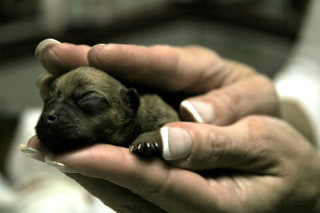
A puppy born prematurely or taken by section too early is very different from a small puppy in a larger litter that was whelped naturally or sectioned after the onset of labor. An early puppy has thin hair around its eyes, nose, back skull, and legs. The coat is dull, and it is difficult to get started after birth. It needs oxygen and constant rubbing to stimulate breathing. A small amount of Dopram injected subcutaneously can stimulate the heart and jump start breathing.
Such a small puppy is one that weighs no more than 3 ounces. I have had 2 1/2-ounce puppies survive. It is a long and arduous process to bring them to full, vigorous puppy hood -- but the outcome is well worth the effort.
A small puppy born out of a normal litter is usually the one that is in the horn of the uterus or that has had several larger siblings resting on the placenta during gestation. Such puppies are fully developed visually, but seem weaker. You must watch to make sure that the puppy is always warm and strong enough to nurse. Take the time to plug it in every two hours, and keep other pups from interrupting. If it cannot nurse consistently and does not regain its birth weight within a two-day period, you should follow the procedure that I use for the preemies.
If a bitch whelps early, all the puppies will be preemies. They will be slow to resuscitate after birth, and it will be difficult to maintain their body temperature. After a preemie is breathing, place it next to a covered hot water bottle in a covered box. The pup and mother should travel separately. At home, have a small whelping box (24”x 36”x 6”) ready, with a covered (two layers of cotton flannel) heating pad at one end, set on the lowest setting. Have a heat lamp on an adjustable pole -- but do not place it directly over the box.
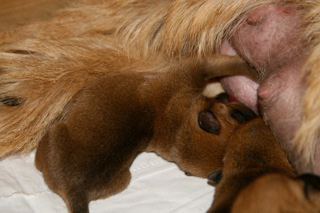
Usually, if a litter comes early, the mother's milk has not come down. It can take two to three days before full production occurs. And this is the period where you must be the most vigilant. Your biggest worry is dehydration. Ask your vet to teach you how to rehydrate by injecting your puppy subcutaneously over the shoulders. Ask your vet to provide three 5-cc syringes with size 25 needles, filled with lactated Ringer’s solution. Ask also for a fifty percent dextrose/water solution in a syringe. (This must be refrigerated.)
In the best case, the preemie will be able to suckle. If it is not strong enough, you must tube feed your pup. I will discuss this process later.) Usually, the mother will have some milk -- and colostrum. It is very important that the pup receives this early nursing, both to transfer immunities and to stimulate further production. If the bitch has had a C-section, she usually will not want to have puppies on her. I lay her down on her side (sometimes having to keep her down) and work with the puppies until each has had the initial nursing. With a preemie, you need to support the puppy and work the nipple into its mouth until it has created a vacuum and is attached. I weigh the puppy after each nursing and start a chart to keep track of gain and loss to the tenth of an ounce. I then put the pup down on the pad and give it a good going-over. If the mother has no interest in cleaning the puppy, I start mimicking the procedure, using a cotton ball dampened with warm water. Usually this will elicit peeing and a bowel movement. I keep the pup on the pad.
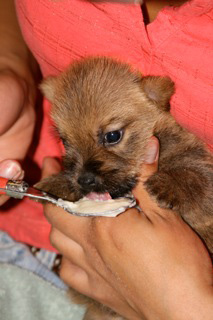
A preemie needs to suckle frequently because its stomach is small, and it isn’t strong enough to stay attached for long period of time. Adding to supplies that you need from your vet, you must have six cans of Esbilac available and 10-cc syringes with no needles. Fill one of the syringes and have it on hand each time you try to suckle the pup. If the puppy is weak and will not suckle, put two drops of the dextrose solution on its tongue as you hold it, head elevated, in your hand. Put three drops of Esbilac, one drop at a time, on the pup’s tongue. Wait for the pup to swallow after each drop. This will moisten the inside of its mouth and give it energy to nurse.
Take a nipple and express a few drops of milk on the tip, supporting the puppy against the mother. If you cannot get the pup going and it seems tired, start to feed it the Esblilac very slowly, a drop at a time, until you are able to get two ccs down. This procedure needs to be repeated every two hours. You start the same way each time, always trying to get the pup to suckle first.

After the feeding, whether hand feeding or a natural suckle, weigh your pup and keep a very accurate account of gain and loss. Most puppies lose a few tenths of an ounce the first few days. Although the mother has milk, the heavy supply doesn’t usually start for two or three days.
Weight gain is different with each pup. A good rule of thumb is that a pup should double its birth weight at two weeks. Most preemies, however, don’t start to gain until four or five days after birth. Even then, the process is very slow, and you will find yourself getting up several times a night for a week to ten days to make sure that the puppy is nursing and helping it along if it is not.
Check the inside of your puppy’s mouth with your little finger. It should not be sticky. The tongue should be bright pink, and the pup should attempt to nurse on your finger. If the mouth does seem sticky, your pup is dehydrated. (Another indicator is if. when you pinch folds of skin, they remained formed briefly.)
If you detect dehydration, take the lactated ringer’s solution and inject 2 1/2 ccs under the skin above the shoulder blades on the back. (It is easier to do with two people.) A large bubble of the solution will appear under the skin at the base of the neck. Keep the pup in your hands, away from a licking mother, until the bubble begins to absorb. If your puppy is very dehydrated, the bubble will be gone in short order. Otherwise, it should be absorbed in five to six minutes. You will sense a difference in the pup immediately. You can rehydrate two times a day. Check with your vet if you need to do the procedure more frequently.
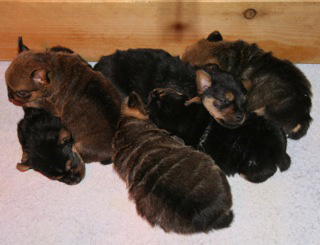
If the mother seems disinterested in cleaning up after her pup, you must assume the role and, after each feeding, stimulate the pup with a moistened cotton ball. Check the anus and make sure that there is no buildup of fecal matter. If there is, dissolve it with warm water and the moistened cotton ball. If the area becomes red, put a small amount of Vaseline on the affected spot. Keep the nose and muzzle free of dried formula or milk.
The more you work with your puppy, the more attuned you will become to picking up signs of trouble. Watch the coat; it should be shiny. Healthy puppies are round and firm. Crying indicates that a puppy is cold, hungry, or in pain. The puppy needs to become active and move about the whelping box. The umbilicus should be dried and separated from the puppy by the third or fourth day. The eyes should open between ten and fourteen days. The mother will clean the eyes, but watch for crusting and, if you find a buildup, dissolve it with a cotton ball saturated with warm water.
If the puppy becomes chilled because of neglect, room temperature, or separation from its siblings, rewarm it gradually. Do not place the puppy on a heating pad. This causes dilation of blood vessels and will actually increase heat loss. Place the pup under your shirt, next to your skin. If its temperature is below 94 degrees F, warming can take as long as two or three hours. Never feed formula to a cold puppy or allow it to nurse. If a puppy is chilled, its stomach and intestines stop working, and feeding will cause it to bloat and vomit. A cold puppy can, however, accommodate a 5-10 percent solution of warmed glucose and water. Give 1/2 cc every hour and warm slowly.
If your puppy is too weak to suckle -- if it cannot form a sufficient vacuum on a nipple -- you will need to feed it by tube. I use tube feeding as a last resort because, once you start tubing, it is usually hard to persuade the pup to suckle, and you find yourself on call every three to four hours for an indefinite period of time. But tube feeding has several advantages.
It takes a short period of time to feed your pup (vs. bottle feeding), and, since no air is swallowed, no burping is required. It also ensures that the proper amount of formula is administered to the pup.
Tube feeding is not difficult to master. It requires a soft rubber catheter (size 5-6 French, available from your vet or in many of the animal catalogs -- e.g. Revival) and a 10 or 20-cc plastic or glass syringe. Have your scale available for monitoring the weight.
Run your thumb and index finger down your pup’s sides. The stomach is located at the level of its last rib. Take the feeding end of the tube and measure from that rib to the corner of the mouth. Mark the measured distance. That is the amount of tubing that you will insert into the pup. Place a piece of tape to mark the catheter.
Ready two syringes, one with warm water and one with warmed formula. Attach the # 5 or 6 catheter to the water syringe and fill the tube with warm water so you can see water flowing from the exit tip. Moisten the exterior of the catheter.
Force the mouth open and start gently to insert to tube following the roof of the mouth down the throat. He will gag and swallow. Keep the tube moving as the puppy swallows. The tube should be too large to enter the windpipe but if you meet resistance, start again. The tube should be swallowed to approximately your mark. He should be wiggling and squirming all the while.
Slowly inject the water into the stomach switch to formula making sure that little to no air gets into the tube and continue to inject formula slowly until it is finished then reattach the warm water syringe and finish off with 2/10 ccs of water. I use 2/10 cc of water at the start of every feeding. This is done to make sure that I have the catheter in the stomach and not in the lungs. A small amount water in the lungs can be easily expelled through the nose and mouth by the puppy... milk cannot without a good chance of aspiration.
Once I see that I have the catheter in the correct place and it is inserted and the water isn’t expelled, I change syringes and feed the correct amount of formula (this depends upon the puppy’s weight). A 3-4 oz puppy is fed 3ccs of formula every 3 hours. Remember as the puppy gains weight you must increase the amount of formula.
You can choose to follow the formula with water or not. I find that it helps hydrate the puppy. It is such a subtle balance when they are so small and water is good to have in the system.
It is easier to accomplish the feeding with two people but you can get the hang of it easily once you have done it a few times and become more confident with your ability to feed your puppy in this fashion.
The object of tube feeding is to strengthen the puppy to the point where he can go back to suckling from his mother. I have had the suckle return within two days and the puppy began to nurse intermittently and then completely on his mom. It was quite a relief to see him gain and then prosper with his littermates when he had totally stopped feeding.
The NubulizerFor about $80.00 you can purchase a nebulizer. Mine is from a company called Pulmo-nate. I find it a good device to have in the house if you are a breeder and there are incidences of small or premature puppies in your litters. Most preemies suffer from lung issues and a nebulizer helps them breath a lot easier. It can clear blocked nasal passages and it helps keep colds and pneumonia from becoming a threat at these early stages.
Place the puppy inside a small puppy carry-all on cotton or soft synthetic blanketing. Cover the carry-all with towels so that it will retain the majority of the steam. Fill and set the nebulizer for 8 minutes, checking occasionally to see if the puppy is responding.
If you can set up a small oxygen feed into the carryall that will add to the capability of the nebulizer and enhance its efficiency. You can purchase a small portable tank, feed and small mask at a hospital supply store for about $60.00 -$100.00.
At this point you have replicated what would be done for your puppy at most any veterinary facility. You have done it quickly. The decisions have been made and effected immediately. This is important with preemies to save them. The prices for this care and individual attention have reached such high levels of cost that it really pays to stock your kennel with these supplies so you can provide immediate and continuing care for your litter.
Tail Docking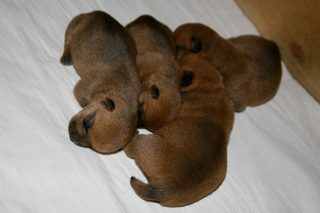
I dock my own tails and remove the dew claws on my puppies. I suggest that you have a vet do this procedure for you. The rule to tell him is a generous third for the length of the tail. This does have exceptions and you need to look carefully at the puppy’s tail and body. If the pup has a longish, thin tail and a longer slight body you are going to have to cut the tail shorter than a third. If you have a chunky pup with a shorter tail that is thick at it’s base you are going to have to leave more of the tail.
Each vet has his own way of doing tails. Let him do the procedure the way he is most comfortable. All tails and dew claws should be done between the ages of 4-7 days. The puppies should be gaining and strong. Preemies should not be done and doing any tails and dew claws at birth is not recommended.
My thoughts about docking/non-docking:
Personally, I would like to see our national club change our standard to read “medium docked tails preferred”. Or list a non-docked tail and possession of dew-claws as disqualifications. As a judge, our current standard restricts me from putting a non-docked dog up for points. It also doesn’t allow me to disqualify the dog. So here sits a very pretty Norwich that by my standards is the best dog in her class and deserves to go winners. I cannot use her and have to put up something less representative of the breed to accommodate the Norwich standard as it is written.
Having judged several times in Germany and attended Crufts and shown in the Worlds, one sees that all dogs in Europe have long tails. It is part of an overall non-docking policy and universally accepted. With more and more dogs being exported and imported it would seem to me that tails should be left on those imported dogs. I think that it is quite traumatic to take the tail and dew claws from a 6-7-month-old puppy. If it was a matter of life and death with a preemie, that is one thing, but to take the tail to be able to show the dog is a bit harsh and there should be access to the show ring for this imported dog with his tail and dew claws.
Wait to do tails and dew claws until the puppy has stabilized. It is not a good idea to do any surgery on a preemie no matter how much it has gained or how normal it seems to you. Any stress on a preemie can knock it back into a danger zone where it will not suckle. You should wait until it is old enough to be anaesthetized (five or six months) and have the surgery performed then. It is more traumatic for the puppy and the healing process takes longer, but the puppy is older and established.

The most unhappy experience of all is losing a puppy that you have brought back to normal condition. This happens with preemies. The puppy seems to hit some invisible wall at about two weeks. It is as though its heart and lungs cannot keep up with the weight gain and the energy level. Your puppy has opened its eyes. It is nursing vigorously and gaining 3/4 to an ounce a day. It is quiet and twitching in its sleep. It’s coat is shiny, and it is moving toward its mother when she enters the box. The mother is cleaning and enjoying her baby. There is no sign of aspiration of milk (milk coming out of the nose), no tearing, and its temperature is in the normal range (98-100).
And then it hits. Three hours later you notice that the pup won’t take the nipple as vigorously as usual and wants to sleep. Then there seems to be a period of discomfort, with the puppy moving around the box and elevating its head on its mother's side or in the corner. Then it will mew. At this point the pup is getting dehydrated, and I inject fluids. The pup needs to be kept warm and you can give it some sugar water on the tongue. Try to get it back to suckling. With a preemie exhibiting these symptoms, you usually lose the puppy in 24 hours. (With a puppy born at a normal weight exhibiting similar symptoms, you may have better luck.)
You should always perform an autopsy. In most cases, you will find that the lungs have not been able to deliver enough oxygen to maintain the growing body of the pup and that this was the cause of death. This is called fetal lung syndrome. Other organs, such as the heart and kidneys, may not mature rapidly enough to maintain critical functions. When you see that one of your puppies is significantly smaller than the rest, prepare yourself. You are not out of the woods until the puppy weighs 14 ounces and will lap a slurry of rice cereal and evaporated milk and water off your finger.
Information from this page cannot be used without permission from the author.
© 2014 Highwood Norwich Kennel. All rights reserved.